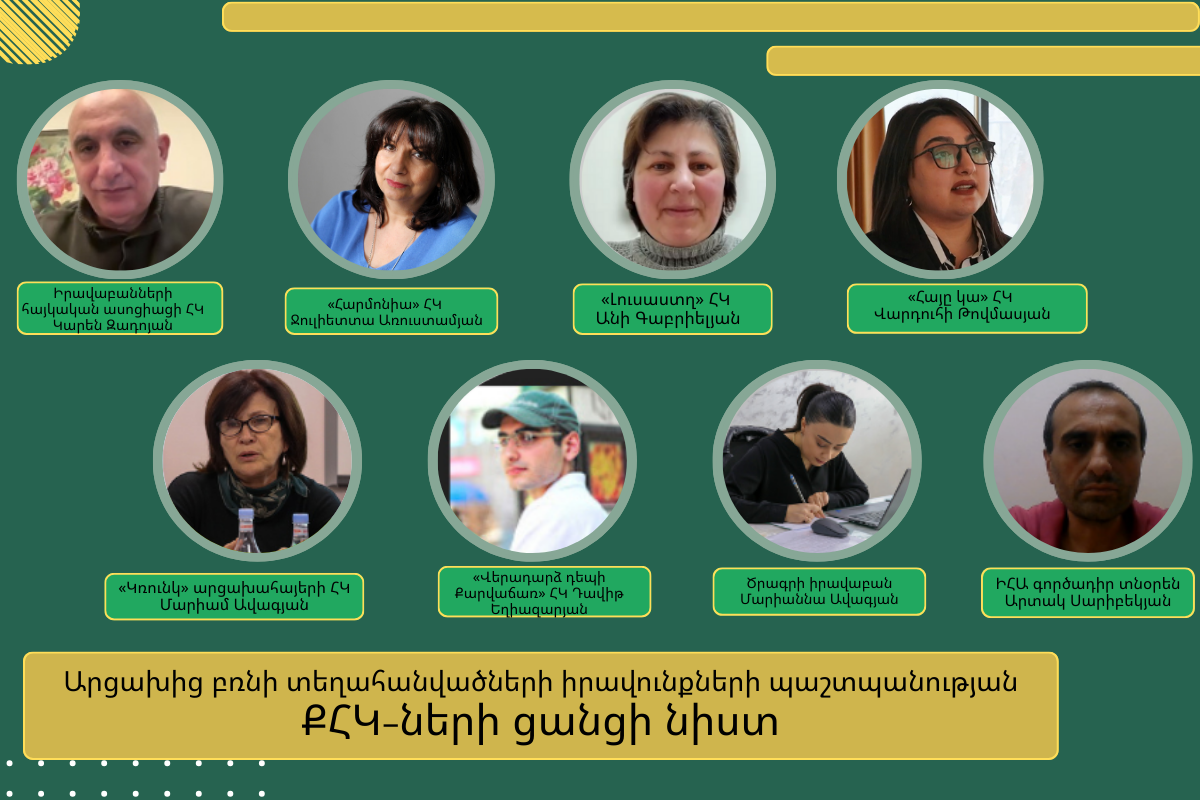
On December 23 of this year, a regular meeting of the Management Board of the CSO Network for the Protection of the Rights of Forcibly Displaced Persons from Artsakh (hereinafter referred to as the Network) was held remotely. The meeting was chaired by the President of the Network’s Management Board, Julietta Arustamyan.
At the beginning of the meeting, the project lawyer, Marianna Avagyan, presented the Network’s activity report for 2025. She provided detailed information on the activities carried out during 2025. In particular, she noted that 140 legal consultations were provided through the Armrights.am platform, while an additional 16 individuals received legal consultations during community visits and at the office. A total of 35 written submissions were prepared and sent to the relevant competent authorities, with the following outcomes: 7 received clarifications, 15 were satisfied, 1 was partially satisfied, 6 were rejected, and 6 are currently under consideration. Four community visits were conducted.
Subsequently, the Network’s Secretary General, Karen Zadoyan, presented the planned directions for continuing the Network’s work in 2026 within the framework of the “Protection of the Rights of Artsakh Armenians” program, namely:
- a) provision of free legal consultations to persons forcibly displaced from Artsakh,
b) raising public awareness about the Network’s activities and the free legal services provided by the Network,
c) collection of legal issues faced by forcibly displaced persons in the sector and, based on these issues, implementation of activities aimed at improving public policy in cooperation with the relevant authorities,
d) presentation of assessments related to the sector in the form of statements by the Network’s Management Board.
The Secretary General also proposed, within the framework of the first direction, to organize online meetings with community members who face legal issues and to provide them with systematic support in the process of resolving their problems. He emphasized that this approach could also be adopted by other Network members, targeting groups of individuals who are in greatest need of legal assistance. Through a remote format or, if necessary, via community visits, it will be possible to provide targeted support, address individual issues, and propose solutions that will improve the situation of beneficiaries and facilitate access to legal services. He stressed that this approach will enable systematic support for beneficiaries, ensure the accessibility of legal services, and allow for a more effective response to community needs.
During the discussion phase, member civil society organizations of the Network presented their observations and proposals, addressing the effectiveness of the implemented activities, existing challenges, and possible directions for future work. The discussions contributed to the exchange of views and the clarification of sustainable formats for continued cooperation.