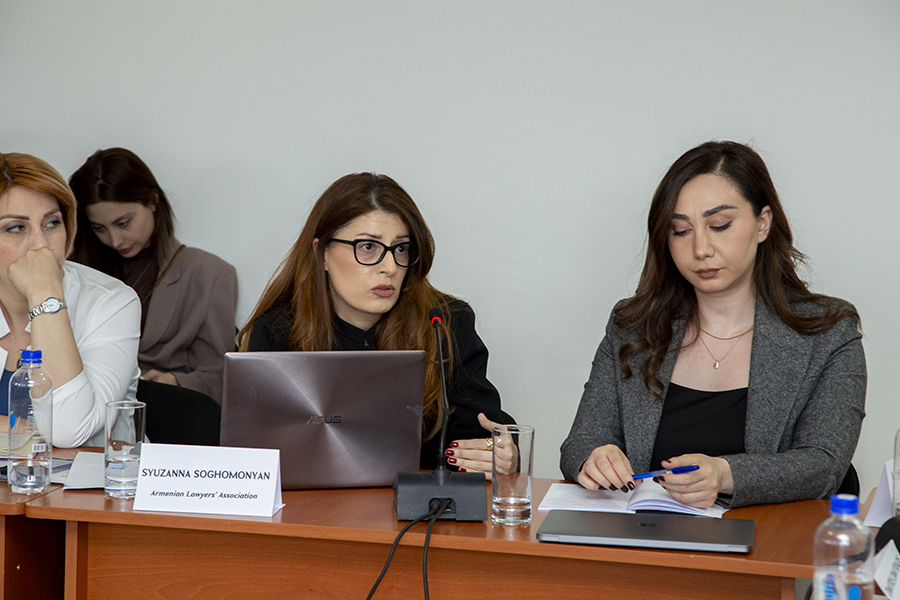
The 6th meeting of the EU-Armenia Civil Society Platform was held in Yerevan on April 1, 2025. During the meeting, Syuzanna Soghomonyan, a representative of the Armenian Lawyers’ Association (ALA), a member of the platform and an anti-corruption expert, presented the progress of anti-corruption reforms in the Republic of Armenia. In her report, Ms. Soghomonyan noted that despite the visible efforts of the Armenian Government in implementing the 2023-2026 anti-corruption strategy, a number of challenges still remain. The ALA is currently conducting a public monitoring of the implementation of the strategy for 2023-2024, and although the final report will be published in May, some results are already evident.
The concerning issues mainly relate to the bodies of the anti-corruption institutional system. Armenia has already completed the formation of the anti-corruption institutional system, but there are serious concerns about certain aspects of their institutional development. In particular, there are concerns about the appointment process of officials of the CPC, Anti-Corruption Committee, and anti-corruption units of the RA Prosecutor’s Office.
The integrity checking process for officials is also a serious concern. In particular, the integrity-checking conclusions are consultative in nature and are not mandatory for decision-makers. These conclusions are not available to the public, and there have been cases where individuals with negative integrity checks were appointed to positions.
It is also concerning that despite the anti-corruption strategy including specific actions to prevent corruption in the private sector, no tangible actions have been implemented in this area. Additionally, there are challenges in the areas of public procurement and criminal liability of legal entities.
There are also issues related to the institution of confiscation of property of illegal origin. In 2022, the constitutionality of this law was challenged, and the Constitutional Court applied to the Venice Commission for an amicus curiae; however, it has not yet made a final decision, despite the Venice Commission having presented its advisory opinion to the Constitutional Court in 2023.
A positive example is the collaboration between the Armenian Government and civil society in raising awareness of society and community servants regarding the whistleblowing system. This example should serve as a model for other aspects of anti-corruption education and awareness.
The meeting was opened by the Platform’s co-chairs: Lusine Hakobyan, President of the “Europe in Law Association” NGO, and Simo Tiainen from the European Economic and Social Committee. Welcome speeches were delivered by Dimitris Dimitriadis, Head of the External Relations Department of the European Economic and Social Committee; Vasilis Maragos, Head of the EU Delegation to Armenia, Ambassador; Arman Yeghoyan, Chair of the European Integration Committee of the RA National Assembly; Samvel Mkrtchyan, Head of the Europe Department of the RA Ministry of Foreign Affairs; and David Cullen, Head of the Georgia, South Caucasus Division of the Directorate-General for Neighborhood and Enlargement Negotiations of the European Commission.
Presentations on the implementation of the CEPA in the areas of rule of law, anti-corruption, human rights, and security were made by Anna Karapetyan, Deputy Minister of Justice of the RA; Armen Ghazaryan, Deputy Minister of Internal Affairs of the RA; Syuzanna Soghomonyan, representative of the Armenian Lawyers’ Association; Hasmik Harutyunyan, representative of the “Protection of Rights without Borders” NGO; and Hovsep Khurshudyan, President of the “Free Citizen” NGO. The presentations were followed by a discussion on the issues raised.
Presentations on social dialogue and labor rights were made by Ruben Sargsyan, Deputy Minister of Labor and Social Affairs; Tiruhi Nazaretyan, Vice President of the Confederation of Trade Unions of Armenia; and Anna Barikyan, Lawyer of the Confederation of Trade Unions of Armenia.
Presentations on industrial and entrepreneurial policy, and the enhancement of the role of SMEs in industry, and in this context, dialogue with business, were made by Lilya Sirkanyan, Deputy Minister of Economy of the RA; Gagik Makaryan, Platform member elected from the Republican Union of Employers; Nerses Karamanukyan, Vice President of the Union of Manufacturers and Businessmen; and Francesco Pietro de Lotto, Director General of the Italian Confederation of Craftsmen, President of the Consultative Commission on Industrial Change of the European Economic and Social Committee.
A discussion followed the presentations.