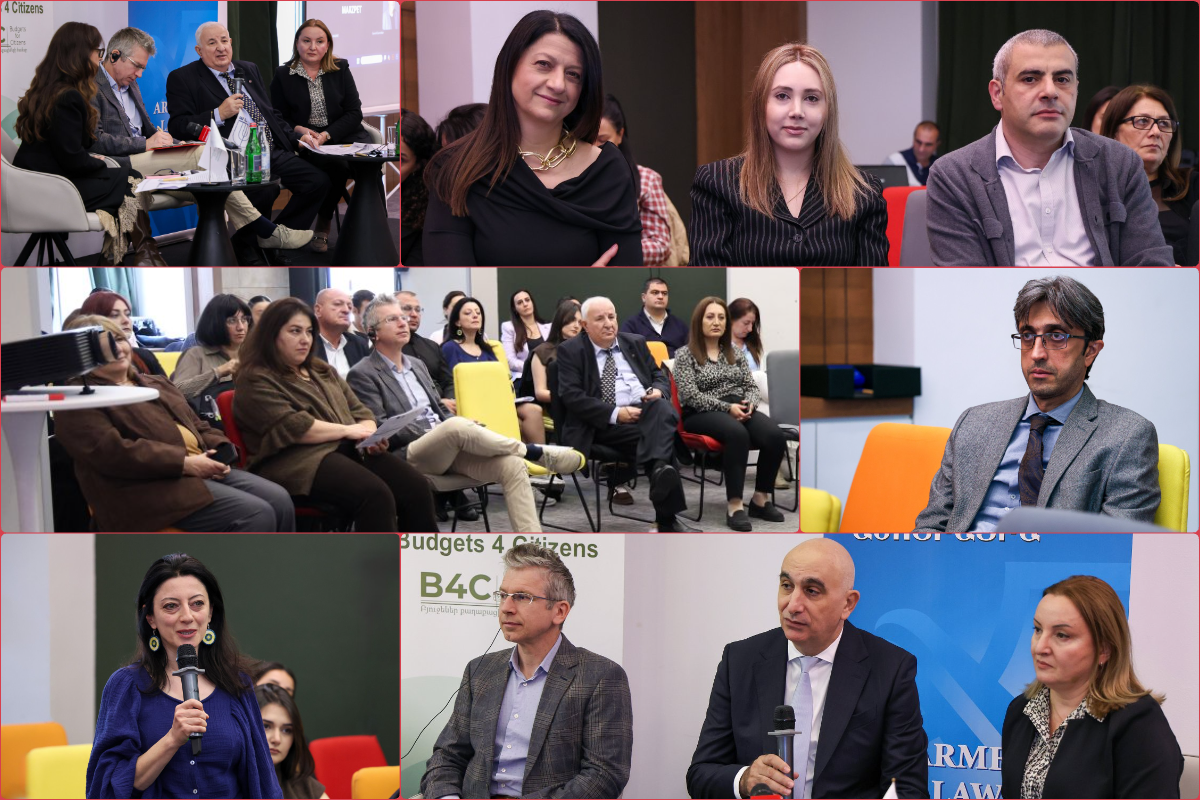
The event “Budgets for Citizens: Public Participation and Transparency” was held in Yerevan on 3 November. The event brought together about 50 representatives of public authorities, international organisations, civil society organisations, and the media. The discussions focused on opportunities for public participation and civil society engagement in budgetary processes, as well as tools for strengthening the transparency and accountability of budgetary decision-making.
The event also provided a platform for exchanging experiences from Armenia and the European Union, particularly the Czech Republic, and exploring practical approaches to strengthening citizen and civil society organisation involvement in budgetary processes.
“For us, it was important not only to strengthen civil society organisations’ capacities to engage in budgetary processes, but also to ensure that these capacities translate into greater transparency and public participation. We are already seeing tangible results. One important achievement is the amendment to the Prime Minister’s decision, which extended the timeframe for public consultations on the draft state budget from just a few days to two months. This gives CSOs (civil society organisations) sufficient time to examine the draft budget, participate in discussions, and submit well-founded proposals,” said Karen Zadoyan, President of the Armenian Lawyers’ Association NGO and Project Manager of the “Budgets for Citizens” project.
Karine Harutyunyan, Executive Director of the Economic Development and Research Center NGO and Coordinator of the Budget Component of the “Budgets for Citizens” project, also delivered remarks, emphasising the importance of the work carried out.
“What mattered here was not only the provision of grants itself, but rather the fact that the organisations receiving them were able to conduct independent research. This provides a solid foundation for the further professional development of young specialists in particular,” she said.
In conclusion, Pia Buller, an Officer at the Delegation of the European Union to Armenia, said: ”The success of the website with more than 40000 visitors shows that there is a huge interest of Armenian citizens in how the government spends taypayers’ money. Knowing what is in the budget is the first step before participating as informed citizens. As the EU we hope that civil society and citizens get actively engaged and the government sees the advantage of listening to citizens’ interests.”
The first panel discussion, entitled “Public Budgets through Public Participation,” focused on mechanisms for citizen and civil society participation in budgetary processes.
The discussion presented EU experience, particularly that of the Czech Republic, in participatory budgeting, followed by an overview of Armenia’s experience, highlighting achievements, existing challenges, and lessons learned.
Presenting the Czech experience, Vojtěch Černý, a representative of Agora Central Europe, highlighted the importance of genuine commitment and adequate resources for effective participatory budgeting.
Presenting Armenia’s experience, Karine Harutyunyan highlighted progress in institutionalising participatory budgeting at both national and local levels. She also mentioned that participatory budgeting was launched in four communities in 2025, while in 2026, more than 51 communities announced their participation in the process.
Movses Aristakesyan, President of the Economic Law Centre NGO and Head of the sub-grant project “Monitoring and Analysis of the Justice Sector Budget,” then presented the significance of the project for its grant recipients and outlined the activities carried out within its framework focusing that monitoring tools were also applied to assess social protection policies and expenditures, with the involvement of both project teams and public administration representatives.
The second panel discussion, entitled “Advocacy in the Budgetary Process,” focused on the tools available to civil society for participating in budgetary processes and representing the public interest.
The discussion presented advocacy experiences from Armenia and the EU, particularly the Czech Republic, and explored mechanisms through which civil society can contribute to more transparent, efficient, and accountable budgetary decision-making.
Jana Stehnová, an expert at Agora Central Europe (Czech Republic), shared the Czech experience and discussed the conditions that make budget advocacy effective and enable civil society to influence public financial management.
Syuzanna Soghomonyan, Advocacy Expert of the “Budgets for Citizens” project, presented the results of budget monitoring conducted within the project, highlighting the importance of meaningful public participation in budgetary decision-making. She emphasised the need to ensure that citizens’ proposals receive reasoned responses from public authorities.
Marine Zhamkochyan, President of the Business and Education Association NGO and Project Lead of the sub-grant project “Advocacy Campaign in the Social Assistance Sector,” shared her experience in engaging with public authorities and influencing budgetary decisions. She emphasised the importance of presenting practical solutions alongside identifying problems, ensuring the continuity of initiatives beyond the project period, and engaging young people.
Background
The event was organised by the Armenian Lawyers’ Association NGO, the Economic Development and Research Center NGO, and Agora Central Europe (Czech Republic), within the framework of the “Budgets for Citizens” project, funded by the European Union.
About the project: The “Budgets for Citizens” project is funded by the European Union and implemented through a partnership between the Armenian Lawyers’ Association NGO, the Economic Development and Research Center NGO, and Agora Central Europe (Czech Republic). The project runs from 8 December 2022 to 7 December 2026.